
Gutter Downspouts in Hilton Head, SC
If water is pooling near your foundation, washing out your landscaping, or running down the side of your house during storms — your gutter may not be the problem. Your downspouts probably are. We’ll trace it to the source.
Why Water Still Pools Even When Your Gutters Are Fine
A homeowner in Bluffton’s Moss Creek community called us after noticing a section of her foundation planting bed was being washed out every time it rained hard. She’d had the gutter cleaning twice that season and assumed one of them was still overflowing. When we walked it, the gutter was draining correctly — right into a downspout that discharged about eight inches from the foundation wall, directly into a low spot in the grade. Every storm was sending several hundred gallons of roof runoff straight toward the base of the house.
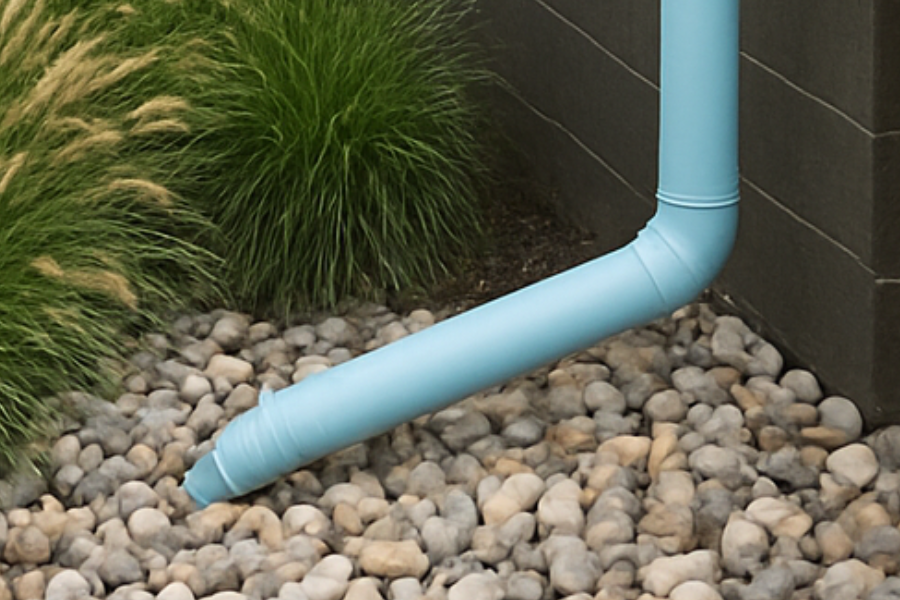
The fix was straightforward: we repositioned the elbow at the bottom of the downspout and added an extension to carry the discharge point further out and away from the foundation. The gutter had been doing its job the whole time. The downspout was doing its job too — just discharging in the wrong place. Once the water had somewhere to go that wasn’t against the foundation wall, the erosion stopped and the planting bed stabilized.
This pattern repeats itself across older homes in Port Royal and Beaufort, and in newer communities like Hampton Lake and Belfair in Bluffton, where lot grading has shifted since the original install. Downspout placement that made sense at construction doesn’t always account for how the yard settles over time or how mature landscaping changes the drainage pattern around the perimeter.
How We Assess, Repair, and Install Downspout Systems
Inspection and Drainage Mapping
Before we recommend a single change, we walk the full perimeter and map how water is moving. We look at the gutter channel pitch above each downspout outlet, bracket condition on the vertical section, downspout size relative to the roof area it serves, and where each discharge point terminates relative to the grade. On properties across Hilton Head Plantation and the older sections of Sea Pines, this walk frequently turns up downspout sizing from the original build that hasn’t kept pace with what a Lowcountry storm season now requires.
The Repair and Installation Process
We handle the full range of downspout work — clearing blockages in vertical sections and elbows, reattaching brackets that have pulled away from the wall, replacing sections that have crimped or corroded, adding new downspout locations to long gutter runs, and repositioning discharge points that are too close to the foundation. When downspout sizing is the issue, we upsize from 2×3-inch to 3×4-inch rectangular or larger round configurations based on the roofline area being served. Every new connection gets non-corrosive fasteners rated for coastal salt air exposure, and every elbow and extension is secured rather than friction-fit, which is how sections separate during wind events, following the professional guidelines established by the NRCA.
Testing and Discharge Verification
Once repairs or installations are complete, we run water through the system at a volume and watch it travel from the gutter outlet through the downspout to the discharge point. We’re confirming the vertical section is clear, elbows aren’t restricting flow, and the discharge point is moving water away from the foundation in the direction the grade intends. If anything in that chain isn’t working, we find it before we leave. We also walk the full perimeter and remove every piece of material and hardware before we pack up.
Questions about whether your downspout count or sizing is right for your roofline? Call (843) 310-0288.
Why Homeowners Across the Lowcountry Bring Us In
We’re locally owned, and Webb, our owner, is involved in every assessment and installation — not handed off to a separate crew after an estimator walks the property. When you call us about a downspout problem, the person who looks at it is connected to the person who fixes it, which means the diagnosis doesn’t get lost in translation.
Here’s what one customer said after a recent job:
“Guys were on time, kept a super clean job site and did a fantastic job with our gutters and downspouts. The guys were incredibly nice and worked hard to get our gutters done right before tropical storm Debby hit. They even finished putting our gutter guards on in the rain. I would recommend this company if you need gutters, top notch service and quality products.” – Matthew B.
We fabricate and install with materials rated for coastal conditions — non-corrosive fasteners, coastal-grade sealant, heavy-gauge aluminum that holds up in salt air rather than corroding at every connection over the first few years. We clean up fully before we leave, and if we find something during the assessment that changes the scope of the recommendation, we tell you before we start rather than after.
Proudly Serving Hilton Head Island Communities
Carolina Seamless Gutters provides gutter and roofing services across Hilton Head Island’s most established neighborhoods and residential communities. From roof replacement and repairs to seamless gutter installation and protection systems, we serve homeowners throughout HHI with solutions built for coastal wind, humidity, and salt air conditions.
How Downspouts Connect to the Rest of Your System
Downspouts sit in the middle of a drainage chain, and problems above and below them both affect how well they perform. The most common upstream issue is gutter pitch. If the channel above a downspout has lost its slope — from hanger failure, debris weight, or fascia shift — water pools in the channel instead of flowing toward the outlet. The downspout is clear and properly sized, but it never gets the chance to drain because the water isn’t moving to it.
Fascia condition is the next upstream variable. When the fascia board behind a gutter section has softened from moisture absorption, the gutter shifts, and with it, the angle of the outlet connection. We look at fascia integrity as part of every downspout assessment rather than treating it as a separate problem.
Below the downspout, we handle the full discharge picture. In communities like Old Town Bluffton and Sun City Hilton Head, where established landscaping and hardscaping limit where a surface extension can go, underground tiling carries the discharge point further from the foundation without disrupting the yard. For homes in Okatie and Hardeeville with larger lot footprints, adding downspout locations distributes the drainage load across a long run so no single exit point is overwhelmed during heavy rainfall.
We also install seamless gutters, gutter covers, handle roof repairs, provide gutter repair, and address fascia damage — so if a downspout assessment surfaces other issues on the roofline, we can handle them in the same visit rather than coordinating multiple contractors.
Call (843) 310-0288 to talk through what we can address together.
How Property Type Shapes the Downspout Conversation Across the Lowcountry
Downspout issues here depend on the building era, roof layout, and site drainage, not a standard fix.
Older Beaufort and historic Hilton Head homes often have long gutter runs with too few downspouts. Today’s summer storms can overwhelm single-exit runs once they push past about 35 to 40 feet. Adding downspouts is one of the simplest, most effective upgrades.
Newer Bluffton communities like Moss Creek and Belfair usually have more downspouts, but discharge points are often placed for construction convenience. Settling and landscaping changes can shift the grade toward the home and reduce drainage performance.
Waterfront and marsh-facing Hilton Head properties can stay saturated in wet seasons. Discharging into already-wet zones can cause erosion or standing water, so routing and discharge placement matter.
Commercial gutters on Route 278 and in Hardeeville need higher-capacity downspouts and more locations, sized to roof square footage, not whatever was installed before.
What Homeowners Can Diagnose and What Needs a Professional Eye
A few things are visible and assessable from the ground without a ladder. If a downspout bracket has separated from the wall and the section is hanging, that’s obvious. If water is running out from behind the gutter rather than through the downspout outlet, the gutter-to-outlet connection has likely failed. If the discharge elbow at the bottom is pointed directly toward the foundation or into a low spot that visibly holds water, that’s a placement problem anyone can identify.
What’s harder to evaluate without getting up there is whether the downspout is the right size for the roof section it’s draining, whether a blockage is in the vertical section or in a buried elbow underground, whether the gutter outlet connection is sealed correctly, or whether the gutter pitch above the outlet is directing flow properly. Those require measurement, access, and familiarity with what typical failure modes look like in this climate. Guessing at the cause and adding elbow extensions or splash blocks without that assessment is how homeowners spend money repeatedly on the wrong fix. Stay safe on the ground, as falls from ladders cause thousands of injuries each year.
If you’ve addressed the visible issues and the problem persists, it’s time to call (843) 310-0288 and have someone look at the full system.
Questions Hilton Head Homeowners Ask About Downspouts
We Serve the Entire Lowcountry
Our work covers Hilton Head Island, Daufuskie Island, Bluffton, Beaufort, Okatie, Hardeeville, Sun City Hilton Head, and the surrounding communities. From waterfront properties on the island to commercial sites along the Route 278 corridor, we make the trip.
If you’re not sure whether you’re in our service area, call us — you almost certainly are.