
Gutter Covers in Hilton Head, SC
Pine needles year-round, live oak tassels every spring, and summer storms that push debris into a channel faster than most cleanings can keep up — if you’re tired of the ladder, gutter covers are worth the conversation. We’ll walk you through what works on this island.
Why Most Gutter Guards Fail on Hilton Head Homes — and What Does Work
A homeowner near Indigo Run had tried two different retail screen systems over four years. The first was a plastic snap-in mesh that trapped pine needles against the fascia instead of shedding them — the needles would mat on top, hold moisture, and the rot started at the fascia line before the gutter even failed. The second was a foam insert that compressed under debris weight and turned into a soil medium for seed germination. By the time he called us, he had small plants growing out of his gutters and fascia damage on the rear roofline that needed addressing with a gutter repair before any cover could go in.
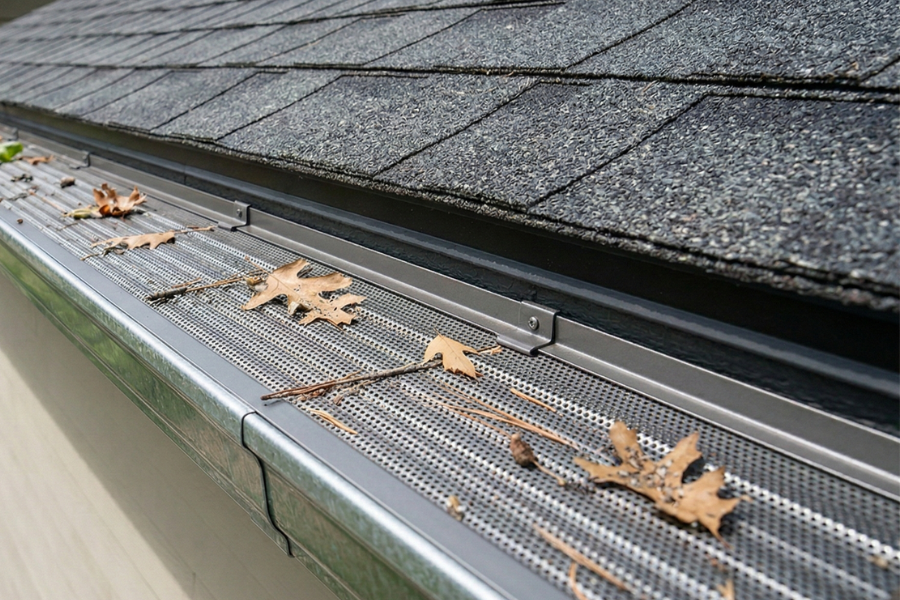
What actually works in this debris environment is a solid-top cover with a curved nose. There are no holes or mesh openings across the top surface for fine debris to enter or accumulate. Water follows the curve and drops into the channel through the narrow inlet at the nose — a gap sized precisely to use surface tension rather than gravity or screen filtration. Oak tassels, pine needle tips, and seed pods sit on top of the curve and blow or wash off the edge rather than working their way into the system. Once we addressed the fascia and replaced the gutter on the problem run, the new cover system went on, and the homeowner stopped calling us for gutter cleaning appointments.
This is the pattern across homes in Palmetto Dunes, Moss Creek in Bluffton, and the older sections of Port Royal — retail guards that weren’t designed for fine debris in a year-round growing season keep failing, and the damage that builds up behind them is always more expensive than the cover system would have been.
How We Assess and Install Your Gutter Cover System
Inspection and System Preparation
We don’t install covers on a compromised system. Before anything goes up, we walk the full roofline and check gutter pitch, hanger condition, fascia integrity, and downspout sizing. A cover installed over a gutter that’s lost its pitch seals in the standing water problem rather than solving it. We verify the channel is draining correctly and that the fascia behind every run is solid enough to hold the new fasteners. We clear existing debris and flush the downspouts so we’re working from a confirmed baseline before the cover goes on.
The Cover Fabrication and Installation Process
Every cover is custom-fit to the exact dimensions of your roofline — we don’t use universal-length sections that require trimming and exposed cuts at the ends. We secure the covers to the gutter and the mounting board using non-corrosive fasteners rated for coastal salt air exposure, which matters in a market where standard hardware corrodes within a few seasons. The nose-forward alignment extends the cover edge slightly past the gutter lip so that debris sheds away from the house rather than piling up at the edge. At corners and valleys where water volume concentrates most, we fit the covers to handle surge rather than just average flow — those are the spots where a generic installation fails first, ensuring our methods align with the standards of the NRCA.
Water Testing and Verification
Once every section is secured, we run a high-volume water test across the full roofline. We’re watching the cover surface — specifically, whether water is following the nose curve and entering the channel cleanly rather than overshooting the edge. Corners and valley intersections get extra attention because that’s where surface tension breaks down under high-volume flow. If anything isn’t performing the way it should, we adjust before we leave. We also walk the full property and pick up every piece of material and every fastener before we pack up.
Want to know whether your roofline is a good candidate for covers? Call (843) 310-0288 and we’ll take a look.
Why Homeowners Across the Lowcountry Trust This Work to Us
We’re locally owned, and Webb, our owner, is involved in every job from the initial walkthrough to the final water test. When you call us for a cover quote, the person who walks your roofline is connected to the crew doing the installation — there’s no estimator who hands off to a separate production team and no scope changes when the truck arrives.
Here’s what one customer said after a recent job:
“We built our house here on Hilton Head about 20 years ago and didn’t realize how much we needed a new gutter system. We had recently put gutter screens on the old gutters, but that did not work for long. Called these guys off a referral and they came out immediately, were very professional and they are excellent at what they do.” – Chris S.
That customer’s experience — screens that didn’t work, a referral to us, and a system that finally held up — is exactly the conversation we have regularly on this island. We fabricate and install on-site, we use materials rated for coastal conditions, and we clean up completely before we leave. If something doesn’t perform after installation, we come back and make it right.
Proudly Serving Hilton Head Island Communities
Carolina Seamless Gutters provides gutter and roofing services across Hilton Head Island’s most established neighborhoods and residential communities. From roof replacement and repairs to seamless gutter installation and protection systems, we serve homeowners throughout HHI with solutions built for coastal wind, humidity, and salt air conditions.
How Gutter Covers Connect to the Rest of Your System
A cover system works best when the full drainage chain is functioning correctly, and an installation is a good opportunity to look at everything while we’re already on the roofline.
The most common connection we address is downspout sizing. Homes throughout Hilton Head Island that were built with 2-inch round downspouts can’t move the volume that a properly functioning covered gutter produces during a heavy storm — the cover does its job, the water enters the channel, and then backs up because the exit point is undersized. We upgrade downspouts to 3×4 rectangular or oversized round when the roofline square footage calls for it, which is common on larger homes in Wexford and along the Buckwalter Parkway corridor.
Fascia condition comes up on almost every job involving older properties in Sea Pines and Port Royal. Years of gutter overflow saturate the wood gradually, and by the time covers go in, there are sections that need repair or replacement before the fasteners will hold. We handle fascia work directly rather than leaving it for a separate contractor visit.
We also install and repair seamless gutters and offer complete gutter cleaning. If a cover system makes sense for your home, we can assess the full roofline, quote the covers alongside any underlying repairs, and complete everything in one visit rather than coordinating multiple trips.
Call (843) 310-0288 to talk through what your roofline actually needs.
How Property Type Changes the Cover Conversation on Hilton Head Island
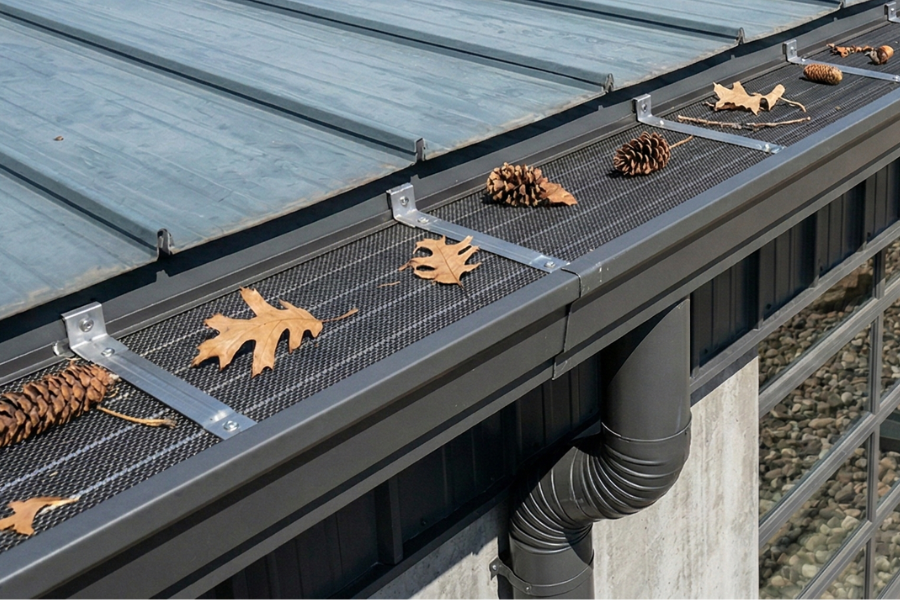
The right cover system and install approach vary across Hilton Head’s housing stock, and matching it correctly is what separates a 25-year install from a 5-year callback. We also provide heavy-duty protection for commercial gutters on local business properties.
Older homes in Sea Pines and early Hilton Head Plantation usually have simpler rooflines. Here, the cover decision is straightforward; the real focus is debris management and fascia condition after years of wear.
Newer builds in the Okatie corridor and off Buckwalter tend to have more complex roof geometry with multiple valleys and longer runs. We pay close attention to valley junctions where surge flow can overwhelm a standard install. If the cover isn’t set for that valley load, it can shed water over the edge instead of into the gutter, something we’ve seen on larger Wexford homes.
Gated communities like Indigo Run, Moss Creek, and Hilton Head Plantation often have HOA appearance requirements. Our solid aluminum covers come in matched colors and sit flush with the gutter line, with no visible mesh, so they blend in from the ground.
What Homeowners Can Assess and What They Can’t
Some evaluation is reasonable from the ground. If you can see debris on top of an existing guard system, if you have tiger stripes or overflow marks on your siding, or if you’ve been cleaning more than twice a year without any improvement — those are all signs that your current approach isn’t matching your debris load. That assessment doesn’t require a ladder.
What you can’t evaluate from the ground is whether your fascia is solid enough to hold cover fasteners, whether your gutter pitch has shifted from years of debris weight, or whether your downspouts are sized correctly for the additional water volume a covered system can channel during a heavy storm. Installing a cover over a compromised substrate is one of the most common reasons cover systems underperform — the cover looks fine, but the gutter behind it is already failing. Those things require getting up there with someone who knows what they’re looking at, which is what we do before every installation. Skipping that step is what turns a good product into a warranty call.
Questions Hilton Head Homeowners Ask About Gutter Covers
We Serve the Entire Lowcountry
We install gutter cover systems across Hilton Head Island, Daufuskie Island, Bluffton, Beaufort, Okatie, Hardeeville, and the surrounding Lowcountry communities. From gated island plantations to newer developments along the US-278 corridor, we make the trip.
If you’re not sure whether you’re in our service area, call us — you almost certainly are.