
Commercial Gutters in Hilton Head, SC
If your commercial property has gutters overflowing during storms, water pooling near tenant entrances or loading areas, or a drainage system that hasn’t been assessed since the building went up — that’s a liability issue, not a maintenance issue. We’ll tell you what you’re actually dealing with.
Why Commercial Drainage Failures Happen — and What They Actually Cost
A Route 278 strip-center property manager called after tenants complained about water sheeting off the front canopy during afternoon storms. The gutters were original, two of four downspouts were partially blocked with compacted debris, and the remaining outlets were undersized for the roof area. During peak rainfall, the system couldn’t move volume fast enough, and overflow ran straight across the main walkway at the tenant entrances.
We replaced the light-duty profile with a commercial-scale system, added two downspout locations to distribute flow, and cleared and upsized the existing connections. That fix carried through the next storm season with no complaints because it solved the capacity problem, not just the visible water. This is why commercial drainage failures get expensive, overflow at entrances increases slip-and-fall exposure, and pooling near foundations can become a structural issue long before it’s obvious on-site.
How We Assess, Design, and Install Commercial Gutter Systems
Site Assessment and Drainage Planning
Commercial drainage starts with understanding the roof’s total surface area across each drainage zone, pitch, and where water naturally moves. We walk the full property, assess the existing installation, and identify where it’s undersized, mispositioned, or deteriorated. For multi-building properties in Bluffton’s commercial corridors and HOA common areas across Hilton Head Island, we assess each structure independently and map discharge routing relative to parking areas, walkways, and landscaped zones — because where water goes after the downspout matters as much as whether the channel is running clear.
On-Site Fabrication and Installation
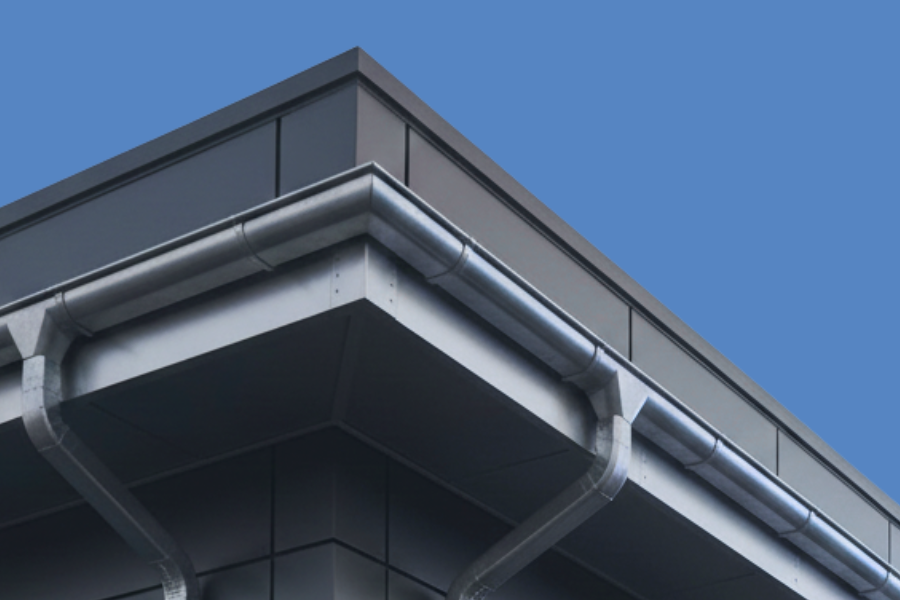
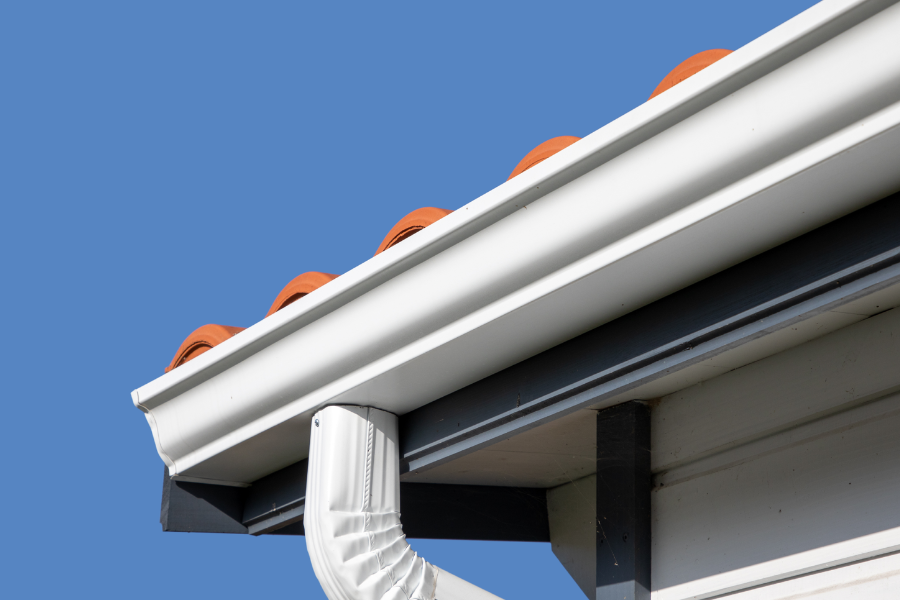
We fabricate commercial gutter sections on-site using the same seamless extrusion process we use on residential work — no mid-run seams on long commercial runs, every section cut to the actual structure. Commercial profiles start at 6 inches and scale up based on roof area and rainfall load. Box gutters and larger K-style commercial profiles handle the volume that flat and low-slope commercial roofs generate in ways that residential-scale systems can’t sustain through a Lowcountry storm season. Downspout sizing, quantity, and placement are all calculated for the drainage zone they serve — not distributed by visual symmetry. All hardware is commercial-grade and rated for the wind exposure and load requirements of the structure, with non-corrosive fasteners for coastal salt air conditions, ensuring all commercial work exceeds the safety and material standards of the NRCA.
Testing, Documentation, and Handoff
Before we hand the property back, we run simulated flow conditions through the completed system. Every downspout outlet gets checked, every section is confirmed to be draining in the correct direction, and discharge points are verified to be moving water away from building entries, parking surfaces, and foundation walls. We document what was installed and where, so the property manager has a clear maintenance record going forward rather than inheriting another undocumented system. If anything in that test doesn’t perform correctly, we address it before we leave.
Questions about sizing, profile selection, or what a commercial assessment involves? Call (843) 310-0288.
Why Commercial Property Managers and HOA Boards Work with Us
We’re locally owned, and Webb, our owner, is involved in commercial assessments personally — not assigned to a project manager who wasn’t part of the original site visit. When you bring us in for a commercial drainage assessment, the person who walks the property with you is connected to the design and installation that follows.
Here’s what one customer said after a recent job:
“We built our house here on Hilton Head about 20 years ago and didn’t realize how much we needed a new gutter system. We had recently put gutter screens on the old gutters, but that did not work for long. Called these guys off a referral and they came out immediately, were very professional and they are excellent at what they do.” – Chris S.
That response — called off a referral, came out immediately, got it right — describes how we approach every job regardless of size. Commercial clients in particular need a contractor who shows up when scheduled and completes the work within the project window, because delays on a commercial property aren’t just inconvenient.
Proudly Serving Hilton Head Island Communities
Carolina Seamless Gutters provides gutter and roofing services across Hilton Head Island’s most established neighborhoods and residential communities. From roof replacement and repairs to seamless gutter installation and protection systems, we serve homeowners throughout HHI with solutions built for coastal wind, humidity, and salt air conditions.
How Commercial Gutters Connect to the Full Drainage Picture
Commercial drainage rarely starts and ends with the gutter channel, and an assessment that doesn’t look at the full system usually misses the actual source of the problem.
On flat or low-slope commercial roofs, internal drains and scuppers work alongside the perimeter gutter system to manage runoff. When those components are blocked or misaligned, the gutter channel absorbs volume it wasn’t designed for — which is why overflow sometimes looks like an undersized gutter problem when the actual issue is a blocked internal drain backing up to the perimeter. We assess the full drainage picture on-site, so we’re not solving one piece while the root cause stays in place.
Below the gutter, downspout routing on commercial properties frequently requires underground tiling or extended surface runs to move discharge water far enough from the building and parking areas. In properties along the Okatie corridor and in Hardeeville’s commercial zones, lot grading and impervious surface coverage affect how aggressively water needs to be managed at the discharge point — particularly on properties where the parking lot drains toward the building rather than away from it.
We also install gutter guards for commercial properties with significant debris load — multi-family buildings and HOA common areas throughout wooded communities on Hilton Head Island and in Bluffton, where debris accumulates in commercial channels as fast as residential ones. Our maintenance programs provide scheduled inspections and gutter cleaning for commercial clients who want the system managed on a regular schedule rather than responding to storm damage. Call (843) 310-0288 to talk about what a maintenance program would look like for your property.
How Property Type Shapes the Commercial Drainage Conversation
Commercial drainage failures in the Lowcountry usually come down to age, roof design, and whether the system was ever sized for real runoff volume.
Older retail and office buildings along Route 278 and Bluffton were often built with light-duty gutters, too few downspouts, and “convenient” discharge points. After 20 to 30 years without a capacity check, the common issues are undersized downspouts, outdated exit locations, and fascia deterioration from repeated overflow.
Multi-family and HOA common buildings typically have long gutter runs serving large roof planes. On a 60-foot section, one undersized or clogged downspout can cause the entire run to fail. HOA requirements in places like Indigo Run and Moss Creek can also limit allowable materials and profiles.
Light industrial and larger facilities in Hardeeville often have flat or low-slope roofs that demand higher-capacity drainage. These sites usually need engineered sizing, larger profiles, and discharge planning based on total roof square footage and impervious surface volume.
What Property Managers Should Know Before Attempting In-House Repairs
Some commercial drainage maintenance and gutter repair is reasonable to handle in-house. Clearing visible debris from accessible ground-level downspout outlets, checking that splash blocks or surface extensions haven’t been displaced, and documenting where overflow occurred after a storm — those are all useful observations a facilities team can make without specialized equipment.
What requires a different level of access and assessment is anything involving the gutter channel or downspout connections above single-story height, anything involving a blocked section inside the vertical downspout run, or any situation where the overflow pattern suggests a sizing or pitch problem rather than a blockage. Commercial structures frequently require lift equipment or specialized ladder staging to access rooflines safely, and an in-house team working without that equipment on a two- or three-story commercial building creates a serious exposure.
We’ve seen commercial properties where maintenance staff cleared debris they could reach and assumed the system was functioning, while a blocked elbow 12 feet up was causing the overflow that was quietly saturating a foundation corner. According to the CDC, falls from ladders remain one of the leading causes of workplace injury.
If you’ve addressed the visible issues and the problem persists through the next rain event, call (843) 310-0288 and have someone assess the full system rather than continuing to treat symptoms.
Questions Hilton Head Property Owners and Managers Ask About Commercial Gutters
We Serve the Entire Lowcountry
Our commercial work covers Hilton Head Island, Bluffton, Beaufort, Hardeeville, Okatie, and the surrounding Lowcountry communities — from beachfront retail and marina-adjacent commercial buildings to large HOA campuses and light industrial facilities inland. We make the trip.
If you’re not sure whether your property is in our service area, call us — you almost certainly are.