
Gutter Guards in Hilton Head, SC
If you’re cleaning your gutters twice a year and they’re still full every time — or you’ve been putting off cleaning because you dread the ladder — guards are worth the conversation. We’ll tell you which system fits your home.
What Happens to a Gutter System When Debris Wins
A homeowner in Sea Pines had his gutters cleaned every spring and every fall for years — he kept up with the schedule better than most. But every time we came out, the rear channel, the one backing up to a dense canopy of live oaks and pines, was packed solid. Between cleanings, it would fill up, overflow during summer storms, and drain back toward the fascia board. After the third cleaning in two years, we noticed the fascia on that rear run was starting to show moisture damage. It was early enough to address, but another season of overflow was behind it, and it would have been a more significant gutter repair.
We installed guards across the rear section where the debris load was heaviest. The next time we came out for his annual check, that channel had a light dusting of fine material along the bottom — nothing affecting flow. The fascia had a chance to dry out. The overflow stopped. He went from two cleanings a year on that section to one, and the system between visits was actually functioning the way it was built to.
This is what guards accomplish in practice: not a maintenance-free system, but a system that stays functional between visits instead of quietly filling up and working against the home. Under the canopy common in Indigo Run, Palmetto Dunes, and the wooded sections of Bluffton, that difference shows up in both what you spend on gutter cleaning and what you don’t spend on fascia repairs.
How We Assess, Fit, and Install a Gutter Guard System
Pre-Installation Assessment and Gutter Prep
We don’t install guards over a compromised system. Before anything goes on, we check the gutters for correct pitch, confirm every hanger is secure, clear existing debris from the channels, and flush the downspouts. Installing guards over a clogged or misaligned gutter covers the problems underneath and makes them harder to catch on the next inspection. In older homes across Sea Pines and Port Royal, this assessment frequently surfaces hanger issues or seam separations that need addressing before the guards go on. We handle those at the same time.
Guard Selection and Precision Fitting
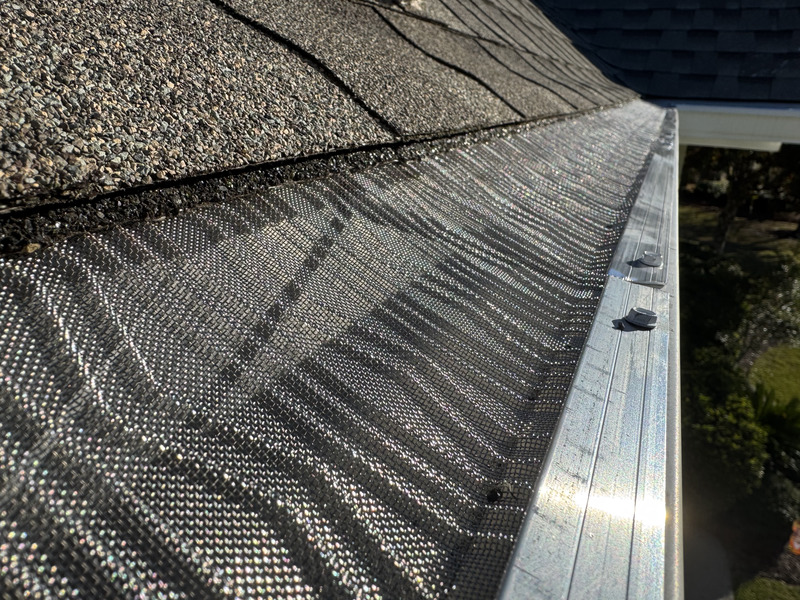
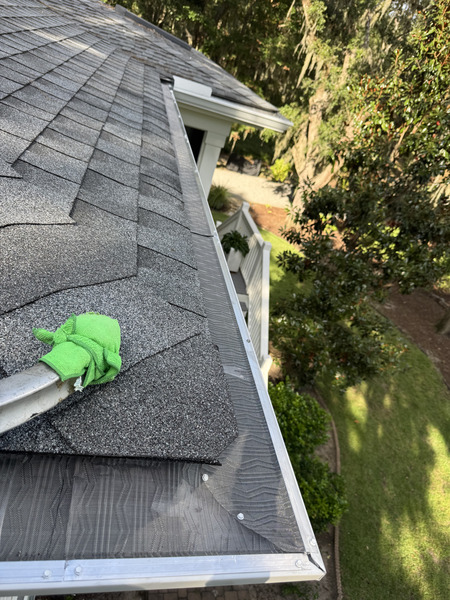
Guard fit matters more than most homeowners expect, and it varies by gutter profile, roof pitch, debris type, and location on the roofline. A guard that doesn’t sit flush with the front lip of the gutter channels water over the side during heavy rain rather than into the channel, which is worse than no guard at all. We match the product to your specific debris profile: micro-mesh systems for properties with heavy broad-leaf load, solid-top reverse-curve systems where debris shedding is the priority, and heavier-gauge aluminum systems for rooflines that see high storm volume. Every section is fitted and secured with non-corrosive fasteners rated for coastal salt air exposure, not retail hardware that starts corroding within a season, ensuring our installation methods meet the high standards of the NRCA.
Flow Testing and Final Verification
Once every section is in place, we run a high-volume water test across the full roofline. We’re watching whether water is following the intended path into the channel rather than shedding over the front edge, and checking that corners and valley sections — where water volume concentrates — are performing correctly under surge conditions. If anything isn’t right, we adjust before we leave. We also clean up all cut material and hardware from the property before we pack up.
Questions about what guard type fits your roofline and debris load? Call (843) 310-0288.
Why Homeowners Across the Lowcountry Come Back to Us
We’re locally owned, and Webb, our owner, is connected to every installation. When you call about guards, the person who walks your roofline knows what gets installed and how — it doesn’t get handed off between an estimator and a separate crew where the details get lost.
Here’s what one customer said after a recent job:
“Guys were on time, kept a super clean job site and did a fantastic job with our gutters and downspouts. The guys were incredibly nice and worked hard to get our gutters done right before tropical storm Debby hit. They even finished putting our leaf guards on in the rain. I would recommend this company if you need gutters, top notch service and quality products.” – Matthew B.
That review mentions leaf guards specifically — and the fact that the crew finished the installation in the rain before a tropical storm arrived is a real story about what showing up on time actually means on this island. We use guard materials rated for coastal conditions, clean up completely before we leave, and if the system isn’t performing correctly after installation, we come back and make it right.
Proudly Serving Hilton Head Island Communities
Carolina Seamless Gutters provides gutter and roofing services across Hilton Head Island’s most established neighborhoods and residential communities. From roof replacement and repairs to seamless gutter installation and protection systems, we serve homeowners throughout HHI with solutions built for coastal wind, humidity, and salt air conditions.
How Guards Connect to the Rest of Your Gutter System
Guards work best as part of a system that’s already functioning correctly, and an installation visit is a good opportunity to look at the full picture while we’re already on the roofline.
Guard Installation Bundled With Cleaning and Inspection
For homeowners in Hampton Lake, Moss Creek in Bluffton, and Port Royal who are adding guards as part of a broader upgrade, we bundle the installation with a cleaning and inspection so everything gets addressed in one visit. If we find hanger issues or seam failures during that inspection, we handle those at the same time — guards going onto a fully functional system rather than one that has developing problems underneath.
Annual Light Maintenance Visits
In communities like Old Town Bluffton and Sun City Hilton Head, where cleaning has been a recurring expense, guards combined with an annual light maintenance visit are usually the most cost-effective long-term approach for homeowners who want to reduce how often they’re managing the gutters without eliminating the oversight entirely.
Seamless Gutter Installation With Guards From Day One
We also install seamless gutters for homeowners who want to start fresh with a new system and add guards from the beginning — so the gutter profile and guard fit are matched from day one rather than fitted to whatever the previous system left behind.
Downspout Sizing and Discharge Placement Adjustments
For homes where downspout sizing or discharge placement is also an issue, we address those in the same visit. Guards reduce debris entering the channel, but if the downspout can’t move water fast enough, overflow still happens during peak storm volume. We look at the full drainage chain rather than just the piece you called about.
Call (843) 310-0288 to talk through what makes sense to address together.
How Tree Cover and Property Type Change the Guard Conversation
Not every home on this island has the same debris profile, and matching the right guard system to the right property requires knowing the difference.
Homes in Sea Pines, Hilton Head Plantation, and the original sections of Port Royal sit under the oldest canopy on the island, live oaks and Loblolly pines that have been growing for 40 to 60 years. The mix of oak leaves, pine needles, and spring pollen creates a debris stream that strains single product solutions, and on these properties, solid top or reverse curve systems often outperform micro mesh over the long run because they shed mixed load more reliably. These are also the homes where fascia condition matters most at the pre install assessment, decades of overflow from undersized or neglected systems often means softwood behind the gutter that needs addressing before guards can be properly anchored.
Newer homes in the Okatie corridor and off Buckwalter Parkway sit on larger lots with younger landscaping, and the debris profile is less dominated by pine and oak. On these properties, guard selection depends more on roof pitch and storm volume than on debris type. Steeper pitches with valley concentration points need a guard system specified for high-volume flow rather than just debris exclusion.
In gated communities, including Wexford, Indigo Run, and Moss Creek in Bluffton, HOA requirements around exterior appearance sometimes affect guard product selection. Our guard systems are low profile and available in colors that integrate with the gutter and fascia rather than calling attention to themselves, which matters in communities where the architectural review board is active. We also provide high-capacity protection for commercial gutters on larger local buildings.
What to Know Before Installing Guards Yourself
Some situations are reasonable DIY territory. On a single-story home with stable, level footing, a homeowner who’s comfortable on a ladder can sometimes install snap-in or clip-on style guards without much difficulty — if the product fits the gutter profile cleanly and the gutters themselves are in good condition.
The calculus changes fast on two-story homes, steep rooflines, or properties where the ground around the perimeter is soft, uneven, or slopes away from the house, which describes a significant number of homes on Hilton Head Island and along the Okatie corridor. Falls from ladders are the leading cause of DIY injuries in this work, and they happen to experienced people. Beyond the safety consideration, the fit has to be precise enough that the guard actually does its job under heavy rainfall rather than creating new overflow paths.
We’ve corrected DIY guard installations where the product itself was fine, but the fit was off just enough — sitting too high at the front lip, not locked down at the back — that the homeowner was getting more overflow than before the guards went on.
If you’re uncertain whether your situation is a good DIY candidate, call us at (843) 310-0288, and we’ll give you an honest answer about whether it makes sense for your specific property.
Questions Hilton Head Homeowners Ask About Gutter Guards
We Serve the Entire Lowcountry
We install gutter guards across Hilton Head Island, Daufuskie Island, Bluffton, Beaufort, Okatie, Hardeeville, and the surrounding Lowcountry communities. From plantation homes under heavy canopy to newer developments with varied landscaping, we make the trip.
Not sure if you’re in our service area? Call us — you almost certainly are.