
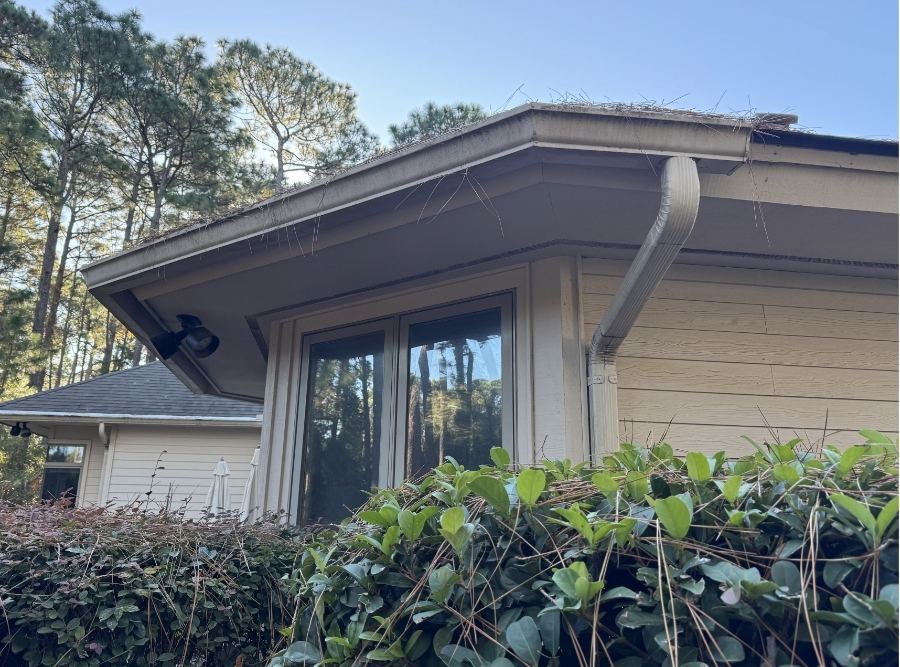
What Are the Dark Streaks on the Outside of My Gutters?
If you’ve looked up at your gutters and noticed dark vertical streaks running down the face of them, you’re not alone. Homeowners across Hilton Head, Bluffton, Beaufort, and Savannah search this exact question every year:
“What are the dark streaks on my gutters?”
The technical name for it is tiger striping.
It’s common. It’s frustrating. And in the Lowcountry climate, it shows up faster than most people expect.
What Tiger Striping Actually Is
Those dark streaks are not rust. They’re not mold growing through the metal. And they’re not necessarily a sign that your gutters are failing. Tiger striping happens when water mixes with roof debris and runs over the front edge of the gutter instead of flowing cleanly through the system.
As water moves off your roof, it carries with it:
- Asphalt shingle granules
- Fine dust and pollen
- Airborne debris
- Organic particles
- Coastal salt residue
When gutters overflow or sheet water over the front lip repeatedly, those particles stick to the exterior paint or coating of the gutter. Over time, they form dark vertical lines, usually spaced evenly apart where water most frequently spills.
In areas like Hilton Head and Bluffton, high humidity and frequent rain accelerate this buildup. The moisture helps debris adhere to the surface, making the streaks darker and more noticeable.
Why It Happens More Often in the Lowcountry
In northern climates, tiger striping may take years to become obvious. In the Southeast coastal region, it can appear much sooner.
That’s because homes in Beaufort, Port Royal, Hardeeville, and surrounding communities deal with:
- Year-round rain cycles
- Heavy pine needle debris
- High humidity
- Wind-driven storms
- Salt-heavy coastal air
When gutters begin to partially clog, often from pine needle mat formation — water no longer flows smoothly toward the downspouts. Instead, it spills slightly over the front edge during rainfall.
That repeated overflow is what creates the streaking pattern. The darker and more defined the lines become, the more consistently water has been moving over the front of the gutter rather than through it.
Is Tiger Striping Just Cosmetic?
Sometimes it is. But often, it’s an early warning sign. If streaking is present, it usually means one of two things:
Either debris is restricting proper flow inside the gutter channel, or the system is slightly misaligned and allowing water to escape over the front edge.
In many cases, professional gutter cleaning resolves the issue by removing internal buildup and restoring correct drainage.
If the streaking is accompanied by visible sagging, separated joints, or repeated overflow in the same area, it may indicate a need for gutter repair.
Ignoring it allows the problem to continue. And continued overflow doesn’t just stain the exterior, it can affect fascia boards and siding over time.
Why Cleaning the Outside Doesn’t Fix the Root Problem
Some homeowners try to power wash the streaks away. While surface cleaning can improve appearance temporarily, it doesn’t address why the streaks formed in the first place.
If water continues to overflow due to internal debris or minor structural issues, the streaking will return. The key is correcting water flow. Once gutters are functioning properly, new striping typically stops forming.
Homes in Savannah, Pooler, Rincon, and Springfield often experience faster cosmetic staining due to the combination of moisture and airborne debris, so maintenance timing matters.
When to Have Your Gutters Evaluated
If you notice:
- Dark vertical streaks forming in consistent patterns
- Water visibly spilling over during rain
- Stains growing darker after storms
- Areas where gutters appear slightly pulled away
It’s worth having the system checked. In many cases, the solution is straightforward. Removing internal debris restores proper flow and prevents additional staining. If sections are misaligned or pulling loose, targeted repair corrects the issue before structural damage occurs.
Across Hilton Head, Bluffton, and the greater Lowcountry, tiger striping is common but it shouldn’t be ignored if it’s paired with overflow.
What Tiger Striping Means for Your Gutter System
Tiger striping isn’t random. It’s a symptom. It tells you that water has been repeatedly moving over the front edge of your gutters instead of through the system as designed. Sometimes it’s purely cosmetic. Often, it signals early drainage problems caused by debris buildup or minor system misalignment. Addressing the cause prevents the streaks from getting worse and protects the components behind the gutter line.
If you’re seeing dark streaks on your gutters, the most effective solution isn’t just cleaning the outside surface, it’s restoring proper internal water flow.
Tiger Striping Is a Symptom, Not Just a Stain
For homeowners in the Lowcountry and Coastal Georgia, dark streaks on gutters are common, especially in pine-heavy and high-moisture environments.
But they’re rarely just cosmetic. They’re a visible indicator that water hasn’t been flowing correctly.
Professional gutter cleaning often resolves the issue. When structural alignment is involved, targeted gutter repair restores performance and prevents further staining.
Correct the flow, and the streaking stops returning.